Showing posts with label travel. Show all posts

Friday, 26 April 2013

Summer Palace in Beijing (photo essay)


China Holidays, Day Tour to the Summer Palace

China Holidays, Day Tour to the Summer Palace


With its handsome buildings, pretty scenery and tumultuous history, the Summer Palace is a wonderful place to explore. The most pleasurable way to escape the crowds is to take a leisurely stroll on the willow-shaded paths and arched bridges that encircle the Kunming lake. The Summer Palace is UNESCO World Heritage Site. 

If you wish to book a day tour of the Summer Palace with English Speaking guide, car and driver please email sales@chinaholidays.com or check our website at www.ChinaHolidays.co.uk 


Friday, 24 June 2011

High Speed Train Beijing Shanghai

The Beijing–Shanghai High-Speed Railway is complete with its new 200mph high-speed rail line that links two of Chinas most important cities, Beijing and Shanghai. The first passenger train will run from the 1st Jul 2011.

The high speed train, also known as the Jinghu High-Speed Railway, began on April 18, 2008 and the final laying of the track was on November 15, 2010. This rail line is the world’s longest high-speed line ever constructed in a single phase. Racing along at over 200 miles per hour this service, making one stop in Nanjing South, takes just under 5 hours to make a full trip. This has taken a whopping 7 hours off the original train journey of 819 miles.

There are two type of high speed train: the 300km/hr train will take 4hrs 48 mins from Beijing to Shanghai  and the 250km/hr train takes 7hrs 56 mins from Beijing to Shanghai.

This service will mean that travellers are able to have a competitive alternative to flying – which takes 2 hours and 10 minutes, but when you including check-in and the all too often flight delays this can take up to 4 hours. 
Specifications

This service is estimated to be used by 220,000 passengers each day – double the current capacity. They hope to achieve this by running trains almost every 5 minutes during peak times. The line is crosses 244 bridges, including the longest and second longest bridges in the world - the 102 mile long Danyang-Kunshan Grand Bridge and the Viaduct Bridge between Langfang and Qingxian at 71 miles respectively. It also passes through 22 tunnels totaling 10 miles.

For booking a high speed train between Beijing and Shanghai please call Julia on 020 7487299 or email sales@chinaholidays.com

Tuesday, 1 March 2011

Garden Tour of China with visit to the World Horticultural Expo in Xian


The World Horticultural Expo will be held in Xian, China from April 28th, 2011 to October 22nd, 2011. That is a six month window of opportunity for any keen gardeners or horticulturalists who would like to see amazing displays of the latest plants. The 2011 World Horticultural Expo is themed as “Eternal Pease & Harmony between Nature & Mankind, Nurturing the Future Earth” It will be held on a new site in Chanba District, between the airport and the downtown.

 
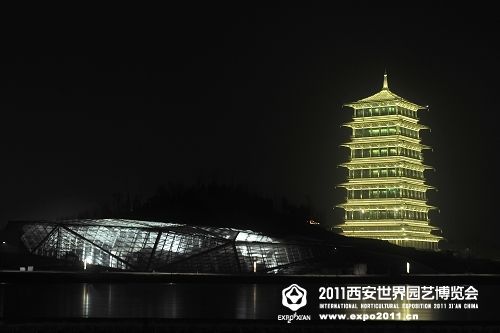
The one of the landmark of the World Horticultural Expo is Changhan tower. Chang'an is an ancient capital of more than ten dynasties in Chinese history, today known as Xi'an.  Chang'an literally means "Perpetual Peace" in Classical Chinese. The exterior styling of the Chang’an Tower has the characteristics of traditional timber-structure pagodas of the Tang Dynasty: every layer of roof overhang has a layer of supporting pedestals with a patterned layer-by-layer structure.

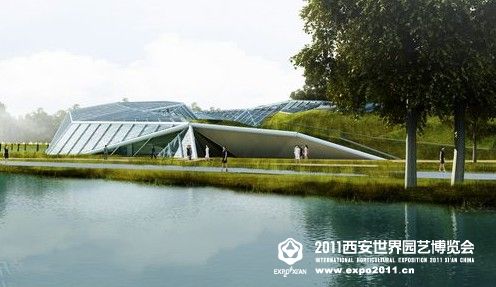
The second landmark of the World Horticultural Expo is The Greenhouse located at the Splendid Lake. Displayed in the house would mainly be rare plants and eco-landscapes from different regions of various climates in the world.

 
The Theme Pavilion, the third landmark of the World Horticultural Expo is centrally located and was designed to be integrated with the surrounding water and land terrains. Its architectural layout is in the shape of the Chinese character “” consisting of irregular tri-wing geometrical objects.


The Guangyun Entrance, fourth landmark of the World Horticultural Expo 2011 Xi’an is the main entrance made up of water features and square flowers gardens, with horticulture features paving the way and well-integrating with the Chang’an Flower Valley.

The World Horticultural EXPO will feature three service zones to display the terrific architectural complexes mixed with vast and beautifully arranged landscapes.
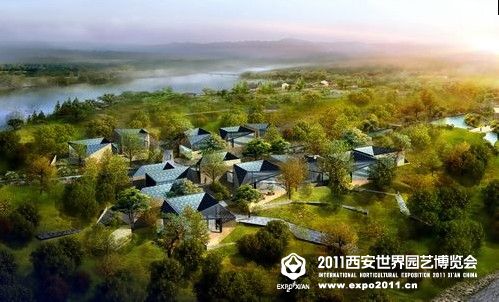
1)       “The Romance by the Ba River” Service Zone displays a village environment full of fields and gardens as well as fun. After appreciating the varied expo landscapes, the visitors will feel calm and relaxed when they come to this zone.
2)      “The Southeast Asian Park” symbolizes the essence of nature, health and recreation. Coconut trees, palm trees and other various tropical plants decorated by abundant bushes make a vigorous world of tropical gardens.
3)      “The European Street” service zone design is based on the extraction of traditional European royal horticultural styles (such as geometrical-pattern landscape planning) with the combination of typical planning characteristics (the combination of axes, square, obelisk, oblique and linear blocks; typical urban texture like foundation and inside courtyard) of European urban residences as well as countries and towns.

There are three Featured Parks showing achievements of Chinese architecture and the latest developments in landscape gardening.

1)   Poetic Landscape in Chang’an Park - reproduce the beauty of the plants described in The Book of Songs and certain techniques were adopted in the design to evoke a traditional Chinese cultural ambience. The scenery reflects the profound and ancient Oriental culture, show the vicissitudes of the Qin Dynasty and reveal the challenges posed by the ecological crisis of our day.
       2)  Qinling Park Aiming at displaying the bio-diversity of Qinling Mountain the Xi’an Horticultural Expo introduces to the exhibition the “Four Treasures of Qinling”: panda, takin, crested ibis and golden monkey. In order to show the harmony between human and nature, the design of animal cages and exercise yards in the Qinling The Park is skilfully done according to the actual land shape, following tightly the principle of merging into the environment. Visitors can go to the Panda Valley to see the charmingly naïve pandas or go to the Lack of Crested Ibis to see the dance of the “Oriental Ruby”. They can also sit in the mountain and watch golden monkeys playing around.
3)   Chang’an Park has a design theme as “interpretation of new concepts of green, ecology and Chinese style”. It has Space Plants & Space Science Education Exhibition Zone, Bamboo Culture Exhibition Zone, Herb Culture Exhibition Zone, Cultural Water Front Exhibition Zone, and Peonies Exhibition Zone.

China Holidays, leading China Specialist organises Garden tour of China with two days visit to the World Horticultural Expo in Xian. The unique tour departs on the 9th Septembers and includes visits to Beijing, Xian, Guilin, Yangshuo, Suzhou, Hangzhou and Shanghai. The tour includes visit to the Botanical gardens of Beijing and Guilin with local horticultural expert. For more information please check China Holidays website, email us at Sales@ChinaHolidays.com or call us at 020 74872999.


Thursday, 17 February 2011

Etiquette How to Eat Chinese Food


It's fine to use a fork instead of chopsticks; to transfer food from a serving dish to your bowl with a spoon; to shovel rice into your mouth with a ladle. Just don't use your hands on the food. "People will think you are Mongolian," said my guide, as I pushed rice on to my chopsticks with a finger.
If you finish everything on your plate (or every last sip of tea), it's a sign that you want more and the host/waiter/waitress will top you up. If you want to be very cool, knock gently on the table with your knuckles to say thanks for the refill.
Never leave your chopsticks standing upright in food. It's a death omen.
The closer to the tips you hold chopsticks, the more open and honest you are.
Never leave your chopsticks pointing at anyone - it's considered very rude. For the same reason, always point the spout of a teapot away from people.
When drinking tea or eating noodles, slurp as loudly as you can (very hard for a polite English person). If you don't, it's a sign that you're not enjoying it.
Don't be afraid to dig into shared dishes with your chopsticks - but take your cue from Chinese hosts. Since Sars, some people have been more reluctant.
Alcohol is not taboo; though tea will be served automatically, and in abundance, it's fine to order a beer or a glass of wine with your meal as well.
There is no "correct" order in which to eat food: cold hors d'oeuvres usually come first, hot foods such as soup often last. Rice is sometimes offered only at the end of the meal, a cheap way to fill up if you're still hungry. In reality, all courses come at the same time, and it's stressful - but stay calm.
The Chinese don't mind eating sweet cakes, then salty soup; or fruit and savoury food on the same plate. It's easy to feel intimidated, but the Chinese are less bound by convention than we are.

For more information about China please email sales@ChinaHolidays.com or call 020 74872999